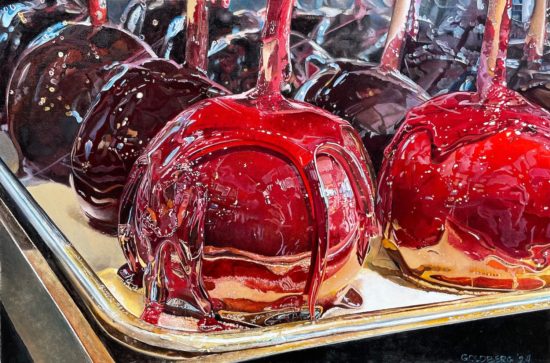
Ann Goldberg’s practice is one of veneers, surfaces, and reflections. Even when the subject is a botanical still life, the action seems contained in the interplay of light with surfaces and material form. There is a significant formal challenge in representing moving water, aluminum foil, plastic, and glass - the Dutch painters had a veritable glossary of words referring to the play of light upon a surface - but conceptually, she is engaged in considerations of commodification, desire, seduction, and illusion. She approaches her subjects as a consumer. The gleam of an industrial baking tray, the metal and glass of barware, and a tin can of SpaghettiOs occupy the same category: they are seductive objects of industrial design, treated with the same devotion as the linen and wicker in a genre painting.
Image-centric social media forms such as Instagram shift our modes of consumption so that the moment of consummation is delayed and transformed into a tangible pleasure - that of viewing the thing as a seductive image - distinct and separate from the thing itself. In other words, desire is no longer imagined to be satisfied by the sensuous pleasure of eating a candy apple, but in the later restaging of it for the pleasure of a viewing public.
Goldberg connects these observations to considerations on the changing forms of labour undertaken by contemporary artists, whose professional success depends as much on mastering the techniques of marketing and digital literacy as it does on the skillful employment of colour theory and draughtsmanship. Her work, while appearing to be straight-forward representation, is in fact conceptually complex, with the paintings presenting images of real-world things that have been staged to appear in their most interesting and seductive way – as with images in IG – but in fact are subtle critiques of the curation of images that we all engage in when we are ‘sharing’ on social media.
The transmutation of the subject is central to Goldberg’s practice, and this process is a critical element in the form and meaning of images she is using and creating. She uses photography to mimic the ideal IG image, and while these original photos, of which there are a few in the exhibition, seem ideal for posting, she primarily uses these as a basis for creating her hyper-realist paintings. These paintings can be considered the final product of her labour, but they also could be seen as the penultimate step in the image making process; a four-stage transformation from real-world thing, through photographic documentation, to painted representation of the photograph, and back to a photograph of the painting that may well be posted on social media.
Image:
Ann Goldberg, Candy Apples III, 2024, Oil on Canvas, 24x36 in.